Bambu Lab X1C Reviews: See Why 0 Shoppers Rated It 0 Stars!
It’s not just hype. The Bambu Lab X1C 3d printer earned its 0/5 from 0 real users. But what’s behind those stars?


 Recaptor
 Bambu Lab X1 Carbon: A Comprehensive Review of an Advanced 3D Printer
The Bambu Lab X1 Carbon stands out as a versatile FDM/FFF 3D printer designed for both consumer and professional markets alike. Released in 2022, this model aims to blend ease of use with industrial-grade features, making it suitable for a wide range of users from beginners to experts. On paper, the X1 Carbon combines precision, build volume, and smart connectivity, promising an efficient and high-quality printing experience for applications from prototyping to complex engineering projects. But does it really live up to its numbers?
Detailed Specs & Features
At its core, the X1 Carbon embraces a prebuilt CoreXY frame design enclosed in a closed chamber, which helps maintain optimal printing conditions. This printer operates within a standard power supply voltage range of 100-240 volts and boasts an energy-saving mode to reduce consumption from its rated 1000 watts. Its internal power supply ensures a streamlined setup without additional bulky adapters.
Regarding build capacity, it offers a generous cubic build volume of about 1023.77 cubic inches (or a 10.08-inch cube), providing ample room for most professional parts and prototypes. The build plate itself is flexible, removable, and finished with a textured PEI surface, ensuring excellent print adhesion and easy removal of final products. Notably, the bed can heat up to 248°F, and the single extruder can handle temperatures between 356°F minimum and 572°F maximum.
The extruder uses a direct drive system with quick-swap nozzles in sizes ranging from 0.2mm to 0.8mm, allowing users to optimize between fine detail and rapid printing. Furthermore, a heated chamber supports more demanding prints that require consistent thermal conditions, which improves layer adhesion and overall part strength.
The printer supports a wide variety of filaments, including PLA, ABS, PETG, Nylon, TPU, and Carbon Fiber, alongside compatibility with third-party materials and multi-material printing for up to 16 different materials; an exceptional flexibility feature. Also built in is a filament dry box and auto-loading system, which helps maintain filament quality by preventing moisture absorption, critical for advanced composites.
User Experience & Performance (Based on Specs)
Design & Build
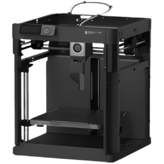
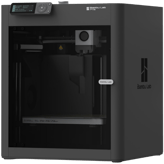
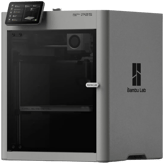
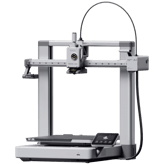
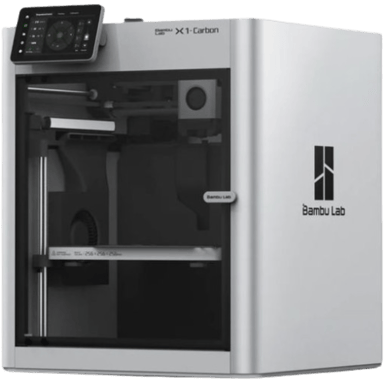
The X1 Carbon measures approximately 15.31 inches in width and depth, standing 17.99 inches tall while weighing just over 31 pounds, making it relatively compact for a professional-grade desktop 3D printer. The fully enclosed design, paired with carbon air filtration, creates a safer and cleaner printing environment, especially important when working with plastics like ABS, which can emit fumes. The inclusion of chamber lighting with both white and RGB color modes provides excellent visibility to monitor prints in progress.
Its touchscreen display and built-in camera enhance usability, allowing for direct interaction and remote monitoring; ideal for users managing multiple printers. The sturdy CoreXY frame, along with linear rails and belts, ensures high precision and durability. Additionally, vibration compensation technology helps reduce print errors related to mechanical movement.
Performance
Print speed is competitive, with official and measured effective rates reaching up to 500 mm/s, positioning it among the fastest desktop 3D printers available. The printer's ability to complete an iconic Benchy test model in just 17 minutes reflects this efficiency. Auto first-layer calibration and PEI print adhesion type reduce setup time and increase print success rates. Plus, features like spaghetti/fault detection and print recovery offer safety nets during long print jobs, supporting continuous prints lasting up to 168 hours.
Operating noise levels at 50 decibels also make the X1 Carbon one of the quieter machines in its class, promising a more comfortable workspace environment. This is particularly important in professional or office settings where excessive noise can be distracting.
Hardware Features
Beyond mechanical capabilities, the printer excels in smart hardware integration. Equipped with an auto bed leveling sensor and filament runout detection, it minimizes user intervention and reduces print failures. The power loss recovery function safeguards ongoing jobs during unexpected outages. Cooling fans are regulated intelligently to maintain optimal temperatures for printing stability.
Its modular toolhead can be swapped for laser, CNC, and plotter functionalities, expanding beyond classic filament printing into multi-tool digital fabrication. Such flexibility is rare in this price range and indicates a future-proof machine designed for evolving maker needs.
Connectivity & Software
Connectivity options include Wi-Fi and cloud support, allowing file transfers via SD card or wireless networks. The custom Bambu Studio slicer software integrates remote monitoring, firmware updates, and multi-printer fleet management, enabling seamless workflow control from mobile apps or desktops. Time-lapse video recording is also available, giving users visual documentation of print processes.
Pros & Cons
Pros
- Exceptional print speed with up to 500 mm/s capability
- Wide material compatibility, including carbon fiber and multi-material prints
- Extensive smart features like auto-leveling, filament runout sensor, and print recovery
- Robust safety certifications (UL, CE, FCC) and enclosure safety features
Cons
- Single extruder limits simultaneous multi-color or multi-material printing without additional modules.
- Proprietary software requirements could limit integration with third-party slicers for some users.s
- A weight of over 31 pounds may challenge portability
Price & Value for Money
With a current retail price around $1249 at BestBuy.com, the Bambu Lab X1 Carbon positions itself attractively in the advanced consumer and professional 3D printer segment. Considering its 1-year warranty period, impressive print speeds, and multi-material capabilities, the pricing feels reasonable for the quality and features offered. Users who value higher throughput, filament versatility, and integrated smart controls will likely find this printer a worthwhile investment. However, those needing multi-extruder functionality out of the box or who prefer open-source software might look elsewhere or wait for upgrades.
Quick Take
In short, the Bambu Lab X1 Carbon impresses with speed, precision, and advanced automation, catering well to a broad user base from beginners to professionals. If we look at the numbers alone, it's a blend of build volume, material support, and smart hardware integrations that sets a high benchmark in desktop 3D printing for under $1300.
Closing Recommendation
The X1 Carbon may be ideal for professionals and hobbyists seeking a fast, reliable, and feature-rich 3D printer without delving into complex assembly. Its advanced safety features and proven build quality help users achieve consistent, high-quality prints across a spectrum of applications. While it has some limitations, like a single extruder configuration and software dependency, its overall performance and versatility make it a compelling choice for the price.
Verdict
Rating: Based on the specifications and overall feature set, we believe Bambu Lab X1 Carbon deserves 4.6 out of 5.
- Winner Feature => exceptionally fast print speeds combined with multi-material flexibility.
- Needs Improvement => limited to a single extruder and reliance on proprietary software.
Reviews 0
The good, the bad, and the brutally honest.Average Rating


More 3D Printers 453
Unlock more awesome finds.